 English
 عربى

Industry News
Home / News / Industry News / How to Choose a Commercial Kitchen Exhaust Hood: Sizing, Codes, and Airflow

How to Choose a Commercial Kitchen Exhaust Hood: Sizing, Codes, and Airflow
2026-10-13
Content
Ask ten kitchen operators how they chose the exhaust hood over their cooking line and you will hear ten different stories. One inherited whatever the contractor had in the van. Another matched the length of the wall and hoped the rest would work itself out. Everything is fine until the menu changes, the duct fills with grease, or smoke drifts into the dining room at the busiest hour of the night.
Choosing a commercial kitchen exhaust hood becomes much easier when you treat it as a system decision rather than a piece of hardware. The hood, the filters, the fan, the duct and the make-up air all have to agree with each other, and they all have to agree with what you actually cook. Below is the sequence our engineers walk through with restaurant, hotel and canteen kitchens every day.
Start With the Cooking Process, Not the Hood
The most important detail is not on the hood at all. It is what happens underneath it: what you cook, how much of it you cook, and what fuel you cook with. Those three answers decide whether you need a Type I or a Type II hood, how heavy the duty rating has to be, and how much air the whole system must move.
Type I and Type II Hoods
Type I hoods are built for cooking that produces grease and smoke. They include a grease removal device — baffle filters, an electrostatic precipitator, a water mist unit or a combination — and they are what you see over fryers, griddles, charbroilers and wok ranges. Type II hoods are for appliances that produce heat, steam, moisture and odours but no grease, such as dishwashers, steamers and some ovens. Confusing the two is the most common and most expensive mistake in kitchen ventilation: a steamer placed under a Type I hood, or a fryer placed under a Type II hood, will not pass inspection and will not perform as expected.
Duty Ratings: Light, Medium, Heavy and Extra-Heavy
Within Type I, appliances are graded by how much grease and smoke they release. A lightly used griddle is not the same animal as a solid-fuel charbroiler running through a dinner rush. That grade — light, medium, heavy or extra-heavy duty — drives the hood design, the filter type, the airflow required per linear foot of hood, and the clearance to combustible construction. Get the duty rating wrong and everything downstream is wrong with it.
| Cooking equipment | Hood type | Typical duty level |
|---|---|---|
| Dishwashers, steamers, convection ovens | Type II | Light, no grease |
| Ranges, griddles, pasta cookers | Type I | Light to medium |
| Deep fryers, woks, high-volume griddles | Type I | Medium to heavy |
| Charbroilers, solid-fuel grills, wok ranges | Type I | Heavy to extra-heavy |
Size the Hood Footprint and the Airflow Together
Hood size and airflow are one decision, not two. The hood has to cover the cooking surface with enough overhang to catch the plume before it escapes — as a rule of thumb, at least 6 inches of overhang on every open side, and a front edge that reaches past the operator's working position. It also has to sit at a sensible height above the cooking surface: too high and the plume spreads before it is captured, too low and nobody can work comfortably.
Airflow is usually expressed in cubic feet per minute, and there is no single magic number. It depends on the duty level, the hood's length and the equipment beneath it. Too little exhaust and smoke rolls out into the room. Too much and you pay for it twice, once in fan energy and again in conditioned air that is thrown away up the duct.
Make-up air is the part most kitchens get wrong. If you exhaust air without replacing it in a controlled way, the building finds the replacement itself — through the front door, the loading dock or the dining room — and the hood feels weak no matter how large the fan is. A balanced design delivers tempered make-up air close to the hood so that capture is not disturbed.
Finally, the fan has to match the whole system, not just the hood. Filters, duct length, elbows, silencers, roof terminations and grease accumulation all add resistance, and that resistance has to be compared against the fan curve at the real operating point. A high-pressure kitchen exhaust fan selected for the actual total pressure drop will hold its performance far better than one picked by airflow alone.
Look Closely at Materials, Construction and Compliance
Once the type and size are settled, the small details decide whether the hood survives a decade of grease, heat and cleaning chemicals.
- Hood shell: stainless steel is easier to clean and resists corrosion, while galvanised steel may be acceptable where the code allows it — check the required minimum thickness either way.
- Grease removal: baffle filters are the baseline, and their quality, spacing and fit affect both capture and fire safety.
- Duct and clearances: grease ductwork has its own rules on material, thickness, joints and distance from combustible construction, and it is usually the hardest item to change later.
- Certification and listing: look for listing to the relevant standard for hoods and grease filters, and confirm what your local mechanical code requires for appliances, fire suppression and access.
- Access: cleaning ports, removable panels and drainage points should be designed in from the start, not added on site.
Decide How Grease, Smoke and Odour Will Be Handled
Capturing the plume is only the first job. What happens to the air afterwards determines how clean the duct stays, how the roof looks and whether the neighbours complain.
Baffle filters are the workhorse. They knock out a large share of the grease, protect the duct and the fan, and cost relatively little — but they only work when they are cleaned on schedule.
For higher efficiency targets, many kitchens add an electrostatic precipitation stage, which charges and collects the finer smoke and grease particles that baffles miss. If your project carries a numbered efficiency figure, it is worth understanding how a commercial kitchen fume purification system reaches 98% efficiency in practice, because the result depends on the combination of stages, the airflow across them and the maintenance behind them.
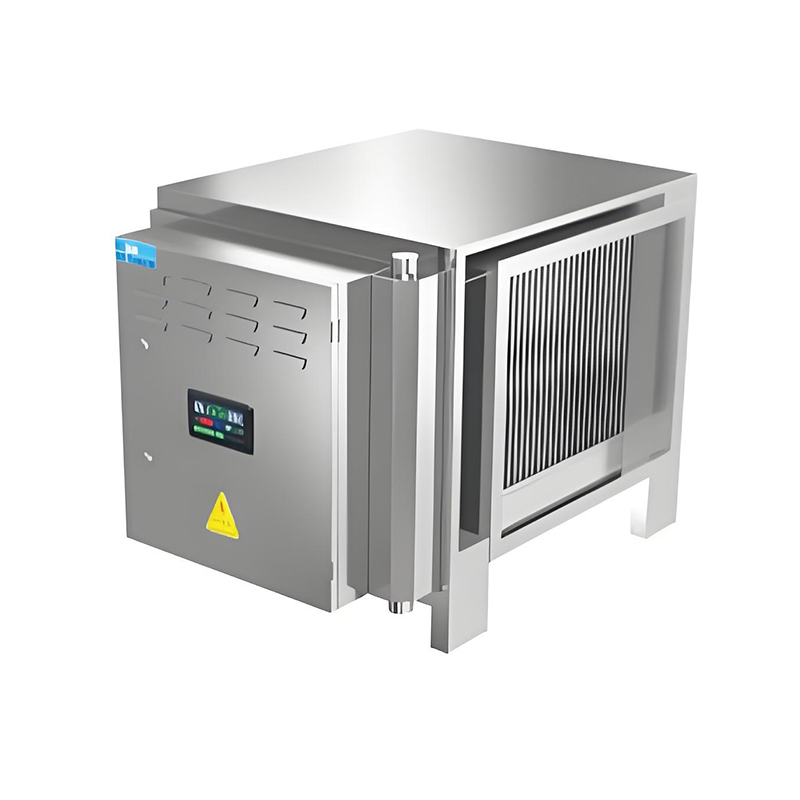
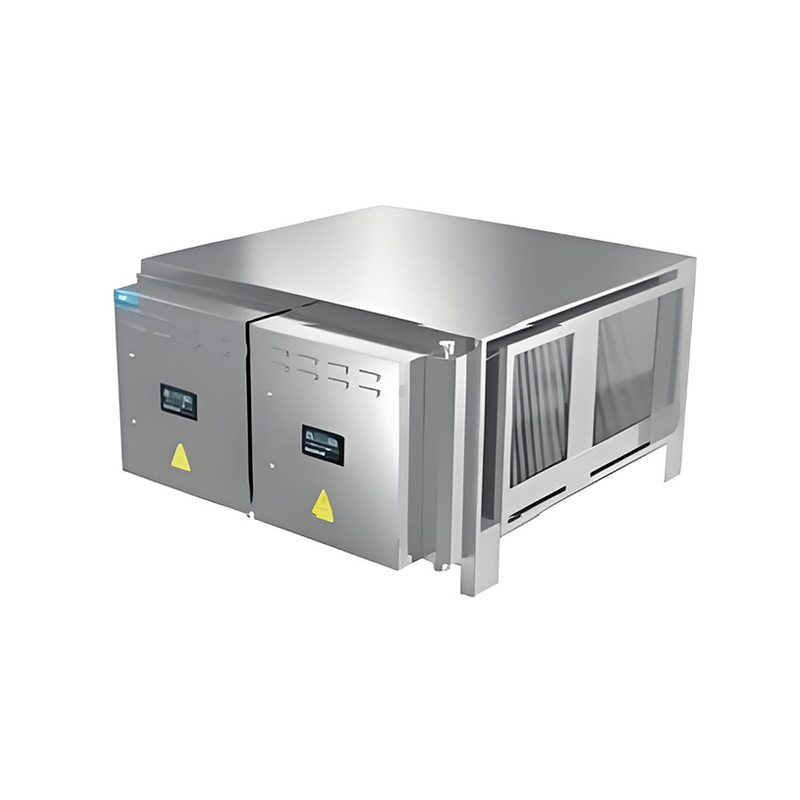 DY-X95 Heavy-Duty Kitchen Fume Purifier with Electrostatic FieldLarge commercial kitchens can use this DY-X95 series purifier, with electrostatic stages handling 4,000–40,000 m³/h and up to 95% purification efficiency.View Product →
Odour is the other half of the problem, and it matters most in dense city centres and in kitchens close to residential buildings. UV modules sit downstream of the grease stages and use ultraviolet light to break down the compounds that carry the smell, which is why they are so often specified together with a high-efficiency purifier rather than instead of one.
 UV Range Hood for Commercial Kitchen Odour and Grease ControlThis 304 stainless steel hood combines UV purification, air curtains and grease collection for kitchens needing odour control and easier cleaning access.View Product →
Plan Cleaning and Maintenance Before You Install
The hood that performs best in year five is the one that was easiest to clean in year one. Before you order, ask who will clean the system, how often, which parts have to be removed, and whether the duct has enough access points for the job to be done properly. Exhaust systems are cleaned far less often than they should be, usually because the job is awkward rather than because nobody cares.
This is where automatic cleaning hoods have changed the conversation. A self-cleaning integrated hood runs a washing cycle over internal surfaces and collection stages, so grease does not get the chance to bake on, airflow stays closer to design, and the fire risk that builds up with heavy deposits is kept under control. It is a real difference in long-term cost, not just a convenience.
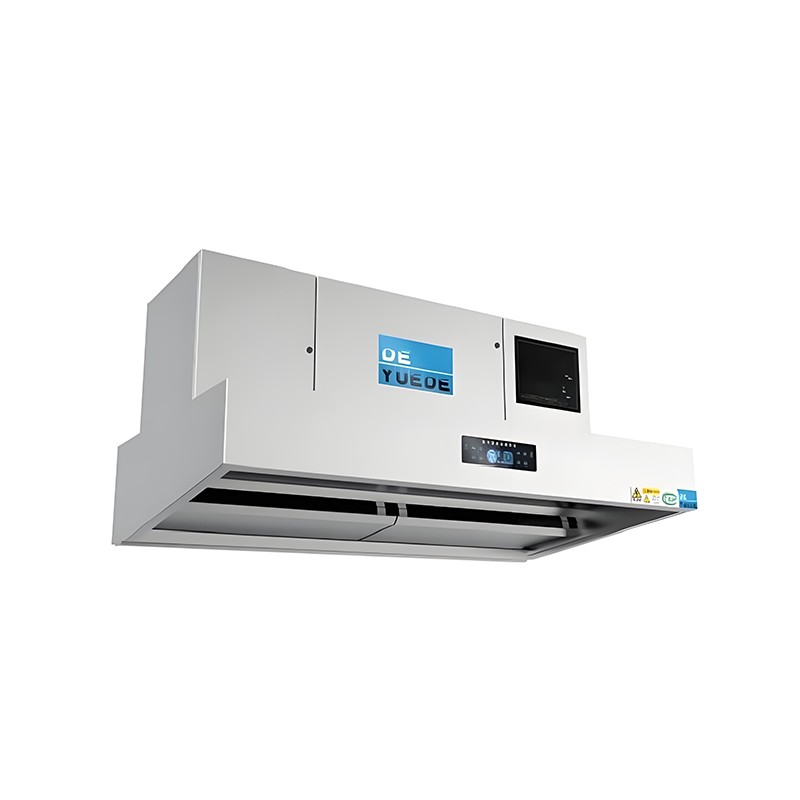
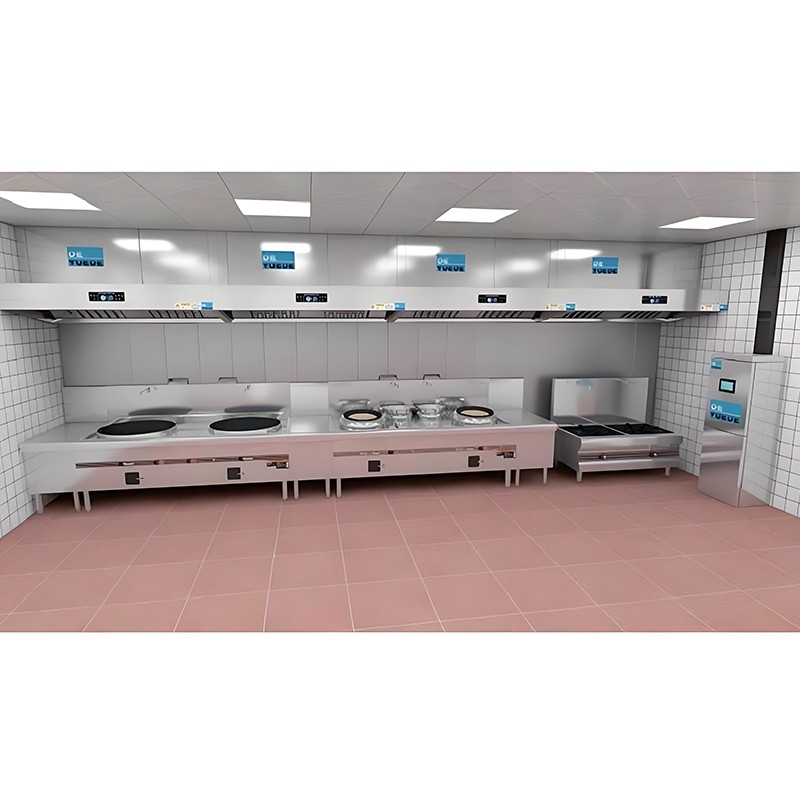 Dual-Module Intelligent Self-Cleaning Integrated Kitchen Exhaust SystemFor heavy-duty kitchens, this self-cleaning integrated system automates washing of dynamic capture and electrostatic modules, maintaining up to 98% purification efficiency.View Product →
A Practical Checklist Before You Order
- List every appliance that will sit under the hood, with its fuel type and expected hours of use.
- Classify each appliance as Type I or Type II and assign a duty level.
- Confirm hood overhang, mounting height and clearance to combustible construction.
- Work out the exhaust airflow with an engineer instead of copying a neighbouring kitchen.
- Design the make-up air at the same time as the exhaust, not afterwards.
- Select the fan against the real system pressure drop, including filters and ductwork.
- Decide which grease, smoke and odour stages you need and what efficiency target they must meet.
- Agree a cleaning and maintenance schedule, and make sure access is built into the design.
- Check listings, materials and duct construction against the local code before fabrication begins.
A commercial kitchen exhaust hood is rarely the most expensive item in a project, but it is one of the hardest things to change once the ductwork is above the ceiling. Start from the cooking, size the hood and the airflow as a pair, and plan filtration and cleaning from day one. Do that, and the hood becomes what it should be: quiet background equipment that nobody in the kitchen ever has to think about.
- No. 505 Lanshang Road, Xinwan Street, Qiantang New District, Hangzhou City, Zhejiang Province
- +86-(0)571-56682212
- [email protected]
Copyright @ Zhejiang Yuede Environmental Protection Technology Co., Ltd. All rights reserved Customized Commercial Kitchen Exhaust System Solution
